

© Roscongress Foundation Photo Bank
The GECF's highest governing body agreed on common approaches to the development of the international gas market and discussed the challenges of global energy security.
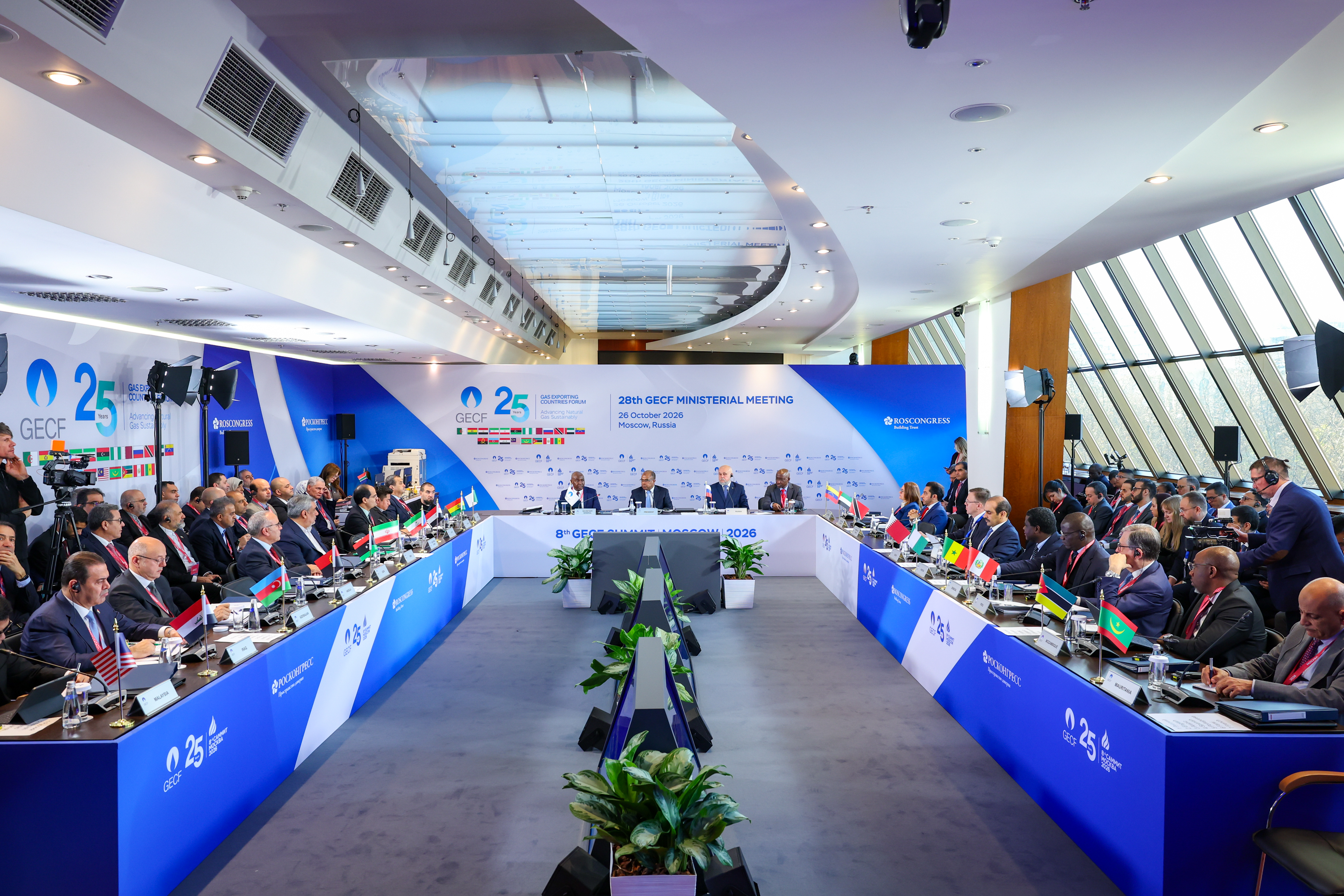
On October 26, 2026, ahead of the 8th Summit of the Gas Exporting Countries Forum (GECF), the organisation's 28th Ministerial Meeting was held in Moscow.
The meeting outcomes set the framework for the Summit, which will take place on October 27, with the Moscow Declaration intended to be the central document of the upcoming event.
Russian Minister of Energy Sergey Tsivilev, opening the session, emphasised the strategic role of gas and condemned unfair competition on global markets.
Amid turbulence on global energy markets, natural gas remains a guarantor of energy security. It is not a temporary solution or a transition fuel, but the foundation of sustainable global economic development. Today, coordination of actions among GECF member countries is more important than ever
The Minister also noted the importance of jointly countering barriers and protecting critical gas infrastructure.
We must jointly remove barriers to the exchange of energy resources and technologies, protect gas infrastructure, expand the GECF and develop cooperation in equipment manufacturing, standards and scientific research. Russia remains committed to the principles of equal dialogue, is ready to share technological experience and expand investment partnership
GECF Secretary General Philip Mshelbila thanked the Russian side for organising the meeting and noted the need to strengthen international cooperation amid global energy challenges.
We meet during a period of continued upheaval: geopolitical tensions and trade fragmentation have weakened trust, and multilateral cooperation has come under strain precisely when collective action is needed most. At the same time, recent events have confirmed the value of long‑term contracts and sufficient capacity to adapt quickly to change. Security of supply requires timely investment across the entire gas value chain. According to our forecasts, by 2050 LNG will account for about 64% of international gas trade, while global gas demand will exceed 5.3 trillion cubic metres
Ekperikpe Ekpo, Minister of State for Petroleum Resources of the Federal Republic of Nigeria and Chair of the 2026 GECF Ministerial Meeting, pointed to the critical importance of gas for the socio-economic development of the countries of the Global South.
We have gathered here not simply as representatives of gas-producing states, but as custodians of a strategic resource, the responsible development of which is vital for global energy security. The key condition for this is maintaining a constructive dialogue between producers and consumers based on mutual respect, common interests and long-term stability
The meeting participants expressed confidence that the Moscow Declaration adopted at the Summit will strengthen the GECF's position as the main international platform for cooperation among leading gas‑producing countries and ensure supply stability in the emerging multipolar world.
GECF participants control 70% of the world's proven gas reserves, 38% of its production, 42% of pipeline exports and 47% of LNG exports.
The GECF's main goals are: promoting the use of natural gas in the global economy, analysing the current state and forecasting the development of gas markets, exchanging experience and facilitating technological cooperation among member countries.